Dead Laptop or Motherboard? Why Chip-Level Repair Outperforms Whole-Board Swaps
When a laptop from Dell, HP, Lenovo, Asus, Acer, or Apple MacBook abruptly stops powering on, authorized service centers almost universally issue a single recommendation: replace the entire motherboard. Here is how power circuits actually fail, why whole-board replacement is rarely necessary, and how precision micro-soldering restores the original board.
How Laptop Power Circuits Actually Work
A laptop motherboard is not a single indivisible block of silicon. It is an intricate electrical network that steps high adapter voltage down through sequential power rails. When you plug in a 19V or 20V charger (or USB-C Power Delivery), that voltage does not flow directly into your processor or memory.
Instead, the current passes through input protection MOSFETs and reaches a series of switching step-down voltage regulators (buck converters). These circuits generate distinct, strictly regulated voltage rails:
- 19V / 20V Primary Rail (VIN / B+): Distributes raw input power across the board to every power management IC.
- 3.3V & 5V Always-On Rails: Power the Embedded Controller (EC / Super I/O), the BIOS chip, and the power button circuit before the laptop even turns on.
- 1.2V / 1.1V Memory Rails: Provide regulated voltage to DDR4 or DDR5 RAM banks.
- 0.8V – 1.05V Core Rails (VCORE / VCCGT): Deliver high-current, low-voltage power directly to the CPU and integrated graphics core.
What Actually Happens When a Laptop Goes "Dead"
In over 80% of laptops brought to our Sky Plaza workshop with "no power" symptoms, the primary processor (CPU) and graphics chip (GPU) are completely undamaged. The failure is almost always caused by a single passive component breaking down on the 19V primary rail:
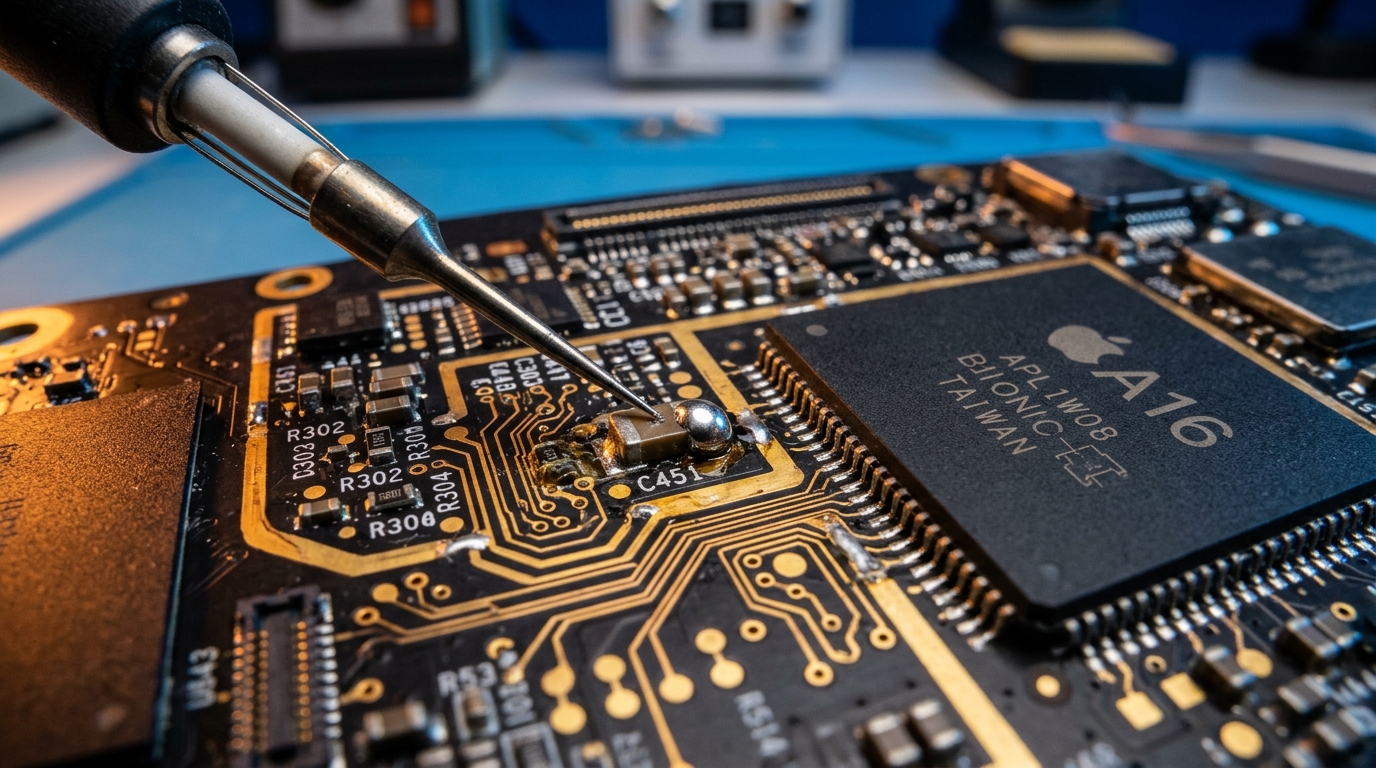
- Shorted Multilayer Ceramic Capacitor (MLCC): Ceramic capacitors filter electrical noise on power rails. Over years of thermal cycling, microscopic cracks develop in the ceramic dielectric layers. Eventually, the capacitor shorts internally, connecting the 19V rail directly to Ground (GND).
- Triggered Short-Circuit Protection: Modern charging ICs contain strict over-current sensing circuitry. The moment a capacitor shorts to ground, the controller detects a dead short and immediately shuts off all power gates to prevent a fire. To the user, the laptop appears completely dead—no LED lights, no fan spin, and zero response from the power button.
- Blown Input Switching MOSFET: Power surges or poor-quality third-party chargers frequently punch through the gate insulation of the primary P-channel or N-channel MOSFETs, blocking adapter power from entering the system.
Why Authorized Centers Mandate Full Motherboard Swaps
Brand-authorized service centers operate on a module-replacement business model. Their technicians are trained as parts assemblers rather than electrical engineers. They do not carry stereomicroscopes, DC bench power supplies, thermal cameras, or BGA rework stations on their service floors.
When their diagnostic test confirms that a power rail has zero volts, their standard protocol is to quote an entirely new motherboard assembly. This approach causes two major problems for the laptop owner:
- Exorbitant Cost: A replacement motherboard often costs 50% to 70% of the price of the entire machine, forcing many owners into unnecessary replacements.
- Permanent Data Erasure: In modern laptops with onboard soldered SSDs (especially Apple MacBooks and thin-and-light ultrabooks), swapping the motherboard discards your physical storage drive, destroying your personal photos, files, and operating system configuration.
The Component-Level Diagnostic Process at Sky Plaza
At Perfect Solution in Sector 16B, Greater Noida West, our technicians isolate and repair the exact electrical failure on your existing board:
- 1. Resistance-to-Ground Measurement: We test every major inductor coil with a digital multimeter to determine which specific power rail is shorted.
- 2. Low-Voltage Current Injection: Using a regulated bench power supply, we inject low voltage (1V–1.2V) into the shorted rail while monitoring current draw.
- 3. Thermal Camera Fault Isolation: The defective shorted capacitor or IC immediately heats up under current, pinpointing the failed component under infrared imaging within seconds without stressing healthy circuitry.
- 4. Microscope Micro-Soldering Rework: Under high-magnification stereomicroscopy, the defective component is desoldered, the board pads are chemically cleaned with rosin flux, and a brand-new factory-rated component is soldered into place.
- 5. Multi-Point Thermal & Stability Stress Testing: Before reassembly, we verify that all voltage rails stabilize under load and test the machine across comprehensive CPU, RAM, and display stress cycles.
Zero Data Loss Guarantee
Because we repair the original board's electrical circuitry, your storage drive is never wiped or replaced. All your applications, desktop files, browser passwords, and personal records remain exactly where you left them.
Have a dead laptop or motherboard in Greater Noida West?
Visit our service desk for a transparent, component-level diagnostic check before you spend money on an unnecessary board replacement. Serving Gaur City 1 & 2, Sector 16B, Cheri County, and Noida Extension.